
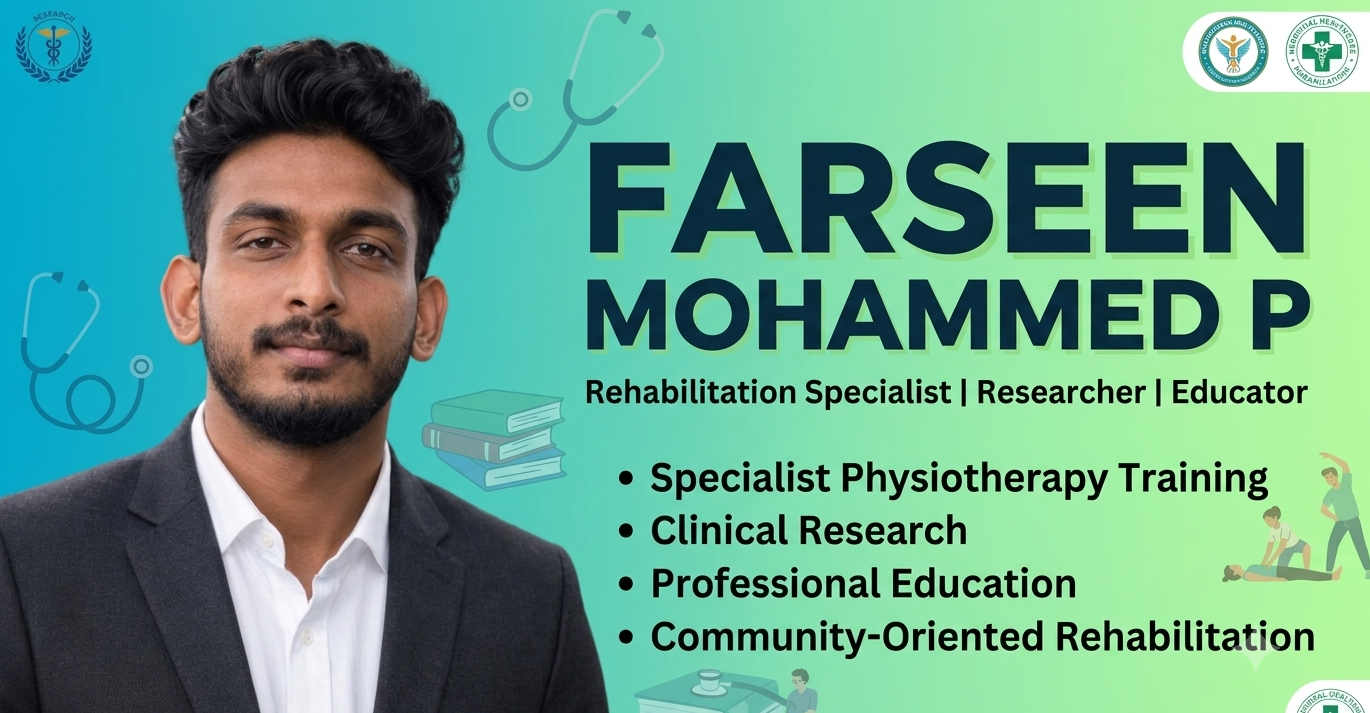
Malappuram, Kerala / Mangaluru, Karnataka: Farseen Mohammed P is developing a multidisciplinary professional profile that combines specialist physiotherapy in neurosciences with an expanding interest in clinical research, therapeutic exercise, rehabilitation science, and evidence-based healthcare. His research portfolio covers several important areas of rehabilitation, including stroke, Parkinson’s disease, cardiac rehabilitation, metabolic health, and exercise-based interventions.
With postgraduate specialization in Neurosciences and Neurophysiotherapy, Farseen Mohammed P has built his academic and clinical interests around conditions in which physiotherapy can play an important role in improving functional outcomes, mobility, independence, and quality of life. At the same time, his research activities demonstrate an interest in examining rehabilitation interventions through systematic reviews, scoping reviews, and clinical research.
A Research Profile Anchored in Rehabilitation
Farseen’s academic foundation includes a Bachelor of Physiotherapy followed by a Master of Physiotherapy in Neurosciences from Yenepoya Physiotherapy College, Yenepoya (Deemed to be University), Mangaluru. His postgraduate specialization has provided a strong foundation for understanding neurological rehabilitation and the clinical management of patients with complex neurological conditions.
His postgraduate dissertation, titled “Effect of Eccentric Versus Concentric Strengthening on Functional Mobility in Subacute Stroke Patients: A Randomized Parallel-Group Comparative Study,” reflects his interest in investigating how specific exercise approaches may influence functional recovery following stroke.
This work connects clinical physiotherapy with research methodology by examining therapeutic exercise through a structured comparative approach. His continued interest in strengthening interventions is also reflected in his ongoing systematic review work examining the effectiveness of eccentric strengthening interventions on functional outcomes in adults after stroke.
Stroke Rehabilitation as a Major Research Interest
Stroke rehabilitation represents one of the central areas of Farseen Mohammed P’s clinical and research interests.
His postgraduate clinical training included exposure to neurological cases such as stroke, Parkinson’s disease, traumatic brain injury, Guillain-Barré syndrome, and spinal cord disorders. This clinical experience has complemented his academic interest in functional recovery and therapeutic exercise.
His research activities have particularly focused on strengthening and functional mobility after stroke. Beyond his dissertation, he has worked on systematic review research examining eccentric strengthening interventions and their potential relationship with functional outcomes in adults recovering from stroke.
His research presentation on this subject received First Prize in the Postgraduate Category at SYNERGOS 2026, where he presented work titled “Effectiveness of Eccentric Strengthening Interventions in Stroke Rehabilitation: A Systematic Review.”
The recognition highlights his growing involvement in research communication and evidence-based rehabilitation.
Parkinson’s Disease and Neurorehabilitation Research
Another important area of Farseen’s research portfolio is Parkinson’s disease rehabilitation.
In 2026, he was the second author and corresponding author of the published scoping review “Timing of Dopaminergic Medication Relative to Physiotherapy Delivery in Adults with Parkinson’s Disease: A Scoping Review.” The study was published in the International Journal of Drug Delivery Technology.
The research examines an important clinical question involving medication timing and physiotherapy delivery in adults with Parkinson’s disease. His involvement in this work demonstrates an interest in connecting neurological medication management with rehabilitation practice.
The Parkinson’s research complements his clinical specialization in neurosciences and contributes to a broader research profile focused on neurological rehabilitation and evidence-based physiotherapy.
Therapeutic Exercise Across Different Health Conditions
Therapeutic exercise is another common theme connecting several areas of Farseen’s research.
While much of his clinical background is associated with neurological rehabilitation, his research interests extend beyond neurological conditions. His ongoing work includes systematic review research on exercise-based cardiac rehabilitation and its potential effects on cardiovascular autonomic function and cerebral outcomes in adults with heart failure and stable coronary artery disease.
He is also involved in research examining exercise interventions for adults with metabolic dysfunction-associated steatotic liver disease, or MASLD. This work considers hepatic, metabolic, functional, and muscle-strength outcomes.
These research interests demonstrate how exercise can be considered not simply as a treatment component within physiotherapy, but as a broader rehabilitation strategy relevant to multiple health conditions.
Evidence-Based Physiotherapy
A major characteristic of Farseen Mohammed P’s academic profile is his emphasis on evidence synthesis.
His research activities include systematic reviews, scoping reviews, clinical intervention research, and evidence-based physiotherapy. He has also completed a five-day international-level hands-on workshop in Systematic Review & Meta-Analysis conducted by the Indian Institute of Research and Analysis, Mumbai, in August 2026.
This additional training has strengthened his methodological understanding of evidence synthesis and supports his ongoing involvement in research projects across different areas of rehabilitation.
His approach reflects the growing importance of evidence-based practice in physiotherapy, where clinical decision-making is increasingly supported by research findings, professional expertise, and patient-related considerations.
Connecting Neurological and Broader Rehabilitation Research
Although neuroscience remains central to Farseen’s professional identity, his research portfolio demonstrates an increasingly broad understanding of rehabilitation.
Stroke and Parkinson’s disease connect directly with his specialization in neurophysiotherapy. Cardiac rehabilitation and metabolic health research expand this perspective into areas where therapeutic exercise and functional rehabilitation also have important roles.
This combination allows his professional interests to extend across different patient populations while maintaining a consistent focus on exercise, function, recovery, and evidence-based intervention.
His postgraduate training, clinical exposure, research projects, and professional development activities collectively contribute to this multidisciplinary direction.
Clinical Experience Supporting Research Interests
Farseen’s research interests are supported by practical clinical exposure gained during his postgraduate training at Yenepoya Medical College Hospital, Mangaluru.
His neurological clinical experience included patients with stroke, Parkinson’s disease, traumatic brain injury, Guillain-Barré syndrome, and spinal cord disorders. His training also included approaches such as Neurodevelopmental Treatment, the Motor Relearning Programme, and task-oriented training.
His broader clinical exposure included musculoskeletal and orthopaedic rehabilitation, post-surgical rehabilitation, manual therapy, therapeutic exercise, and integrative physiotherapy.
This combination of clinical experience and research activity provides a foundation for examining rehabilitation questions from both practical and academic perspectives.
Continuing Professional Development
Farseen has continued to expand his professional knowledge through workshops, certifications, conferences, and academic activities.
His professional development includes certification as an ACE Health Coach, training in Good Clinical Practice, participation in physiotherapy conferences, workshops in systematic reviews and meta-analysis, and training in neurological rehabilitation approaches.
He has also participated in scientific presentations and academic committees, including his role as an Organizing Member of the Scientific Committee for Mangalore PhysioCon 2026.
These activities indicate an ongoing commitment to professional learning and academic engagement.
A Broader Vision for Rehabilitation Research
The breadth of Farseen Mohammed P’s research interests illustrates a developing professional direction in which physiotherapy, therapeutic exercise, clinical research, and evidence synthesis intersect.
From stroke and Parkinson’s disease to cardiac rehabilitation and metabolic health, his research portfolio explores different aspects of rehabilitation while maintaining a consistent interest in functional outcomes and exercise-based approaches.
His academic journey also demonstrates the progression from clinical training to independent research interests, scientific presentations, publication, and continuing methodological development.
As his research portfolio continues to develop, Farseen Mohammed P’s work represents an emerging profile in physiotherapy that combines specialized neurorehabilitation training with broader interests in rehabilitation science and evidence-based healthcare.
His continuing involvement in clinical research, academic presentations, professional education, and interdisciplinary rehabilitation topics positions him to further contribute to discussions surrounding modern physiotherapy and the role of evidence-informed rehabilitation in healthcare.